
Gaultheria shallon
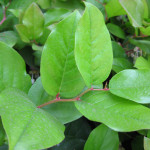
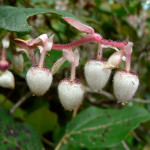
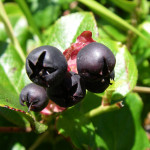
Salal is a low-growing, leathery-leaved evergreen shrub that tolerates a wide variety of conditions. Its dark blue “berries” (actually swollen sepals) are edible raw and can be made into jams, preserves, and pies. Salal berries are mildly sweet, and are often used in combination with the more tart Oregon grape.
In the Willamette Valley, salal prefers full to partial shade. In coastal areas it can form deep, nearly impenetrable thickets, and easily tolerates full sun. It grows as far north as Baranof Island, Alaska.
Salal leaves are also harvested and sold to florists worldwide for use in floral arrangements.
- Light Requirements: Part Shade, Full Shade
- Water Requirements: Dry, Moist
- Ease of Growing: Easy to grow
- Growth Rate: Moderate
- Spreads: Yes
- Wildlife Support: Pollinators, Hummingbirds, Pest-eating Insects, Birds or Mammals
- Fire-resistant: Yes
- Edible: Yes
- Mature Height: 1-5ft
- Mature Width:1-5ft
Oceanspray

Holodiscus discolor
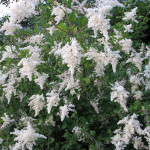
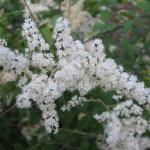
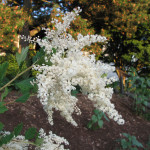
Oceanspray is native to western North America, most commonly found in the mountains of the Pacific Northwest. This fast-growing deciduous shrub gets 8-10′ tall and 3-7′ wide. Its small toothed leaves are 2-4 inches long. Cascading clusters of white flowers drooping from the branches give the plant two of its common names, oceanspray and creambush. The flowers have a faint sugary scent, and each one bears a small, hairy fruit containing one seed which is light enough to be dispersed by wind.
Oceanspray is found in a variety of habitats, from wet coastal forests to drier, cooler mountain peaks further inland. It often grows in areas dominated by Douglas-fir. The plant is found in areas prone to wildfire, such as chaparral communities. It is often the first green shoot to spring up in an area recovering from a burn or logging.
Many small solitary bees, bumblebees, and native butterflies visit this plant for nectar. It can also be considered a pollinator “nursery”, as pale swallowtail, spring azure, Lorquin’s admiral, and brown elfin butterflies all lay their eggs on it.
These attractive shrubs thrive on dry slopes in sun to part-sun, and spread well in favorable conditions. Long-leaf Oregon grape and salal do well in their shade, and they pair well with hazelnut to make a woodland border. Combine with red-flowering currant or vine maple for a deciduous screen.
- Light Requirements: Full Sun, Part Shade, Full Shade
- Water Requirements: Dry, Moist
- Ease of Growing: Easy to grow
- Growth Rate: Fast
- Spreads: Yes
- Wildlife Support: Pollinators, Pest-eating Insects, Birds or Mammals
- Fire-resistant: Yes
- Edible: No
- Mature Height: 8-10ft
- Mature Width:3-7ft
Tall Oregon Grape
Mahonia aquifolium (Berberis aquifolium)
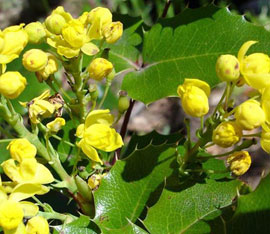
Tall Oregon grape (Mahonia aquifolium) is the state flower of Oregon. The plant is not related to grapes, but gets the name from the purple clusters of berries it produces every fall. Its sharply pointed leaves resemble holly. The bright yellow clusters of flowers in April and May are both a lovely sign of spring, and a welcome sources of nectar for early pollinators including mason bees and bumblebees.
Painted lady butterflies, half-white carpet moths, mining bees, and other insects also use the flowers for food. The berries are eaten by many wildlife, including robins, waxwings, juncos, sparrows, and towhees, as well as foxes, coyotes, and raccoons.
Tall Oregon grape is well suited for low-maintenance plantings or loose evergreen hedges. It grows 5-8 feet tall depending on conditions, so in the garden it serves as a good evergreen backdrop, especially when combined with salal, sword fern, and evergreen hucklebery. Tall Oregon grape tolerates poor soils and summer drought, especially if it has some shade.
- Light Requirements: Full Sun, Part Shade
- Water Requirements: Dry, Moist
- Ease of Growing: Easy to grow
- Growth Rate: Moderate
- Spreads: Yes
- Wildlife Support: Pollinators, Hummingbirds, Pest-eating Insects, Birds or Mammals
- Fire-resistant: Yes
- Edible: Yes
- Mature Height: 5-8ft
- Mature Width:2-8ft