Category Archives: Large Trees

Giant Sequoia

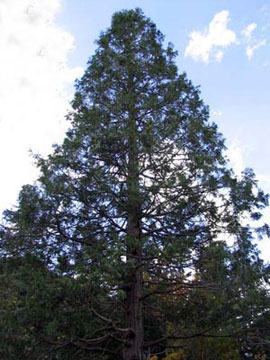
Giant sequoias (Sequoiadendron giganteum) are the world’s largest trees by volume. In the wild, mature trees can reach up to 350 feet tall with trunks 20′-40′ in diameter, supported by broad, shallow roots spreading out 150′ in all directions. These trees are medium to fast growers, reaching heights of 30 feet at 10 years old, and 100-150 feet in 50 years. Trunks can be 1.5′ wide after 10 years and 8′ in diameter after 50 years–and given that these trees can live up to 3,000 years old, they’re just getting started!

Giant sequoias do best in sunny, protected areas with moist, fertile, well-drained sandy loam soils. Though older trees have some drought resilience, young trees need moist roots all year. They will sometimes discolor temporarily in the winter after a hard cold snap, but will return to green with warmth and sufficient water.

While Giant Sequoias used to be widespread across North America, their range significantly contracted after the last Ice Age. While no longer “native” to the Willamette Valley, this magnificent tree is an excellent choice for urban environments in a changing climate. They shade urban landscapes, create windbreaks in open areas, and provide shelter for many birds and small mammals.

Like their cousins the coastal redwoods, plant these enormous trees far away from paved areas, buildings, and power lines. With enough room to grow, giant sequoias are hardy, magnificent plants that bring grace and beauty to any large landscape.

Light Requirements: Full sun
Water Requirements: Moist
Ease of Growing: Easy to grow
Growth Rate: Fast
Spreads: No
Wildlife Support: Birds or Mammals
Mature Height: 200 feet (in urban areas)
Mature Width: 40-65 feet
Coastal Redwood

The coastal redwood (Sequoia sempervirens), while not currently native to the Willamette Valley, is an iconic species of the Pacific coast in northern California and southern Oregon. Like its cousin the Giant Sequoia, redwoods were far more widespread prior to the last Ice Age. Fossil records show it once grew on the Central Oregon coast, and it thrives today as far north as British Columbia. It is unknown what effect climate change will have on its current range, but efforts are underway to save the species from extinction.

Young trees have dense branches and a graceful pyramid shape. Leaves are needle-like and spread out flat on either side of branched, drooping limbs. The beautiful red bark is fibrous and shreddy, providing interesting visual texture and soft nesting material for birds and small mammals. Birds find refuge in the dense foliage, squirrels nest in cavities, and insects and amphibians make their homes in the moss-covered branches.

In the right conditions, these can become the world’s tallest trees, growing over 300 feet high and stabilized by wide-spreading roots. Though they do not tend to get as big in hotter, drier urban areas, young trees still grow 3-5 feet per year and need plenty of room.

These large trees require a lot of water to stay healthy. They do best (and grow the biggest) in humid areas protected from the wind, and prefer deep, moist, acidic, well-drained soil. Plant these magnificent trees well away from structures and power lines where they have room to safely attain their glorious size.

Light Requirements: Full sun to partial shade
Water Requirements: Moist
Ease of Growing: Easy to grow
Growth Rate: Fast
Spreads: No
Wildlife Support: Birds or Mammals
Mature Height: 150 feet (in urban/inland areas)
Mature Width: 50-100 feet

Red Alder

Red alder (Alnus rubra)
Alnus rubra

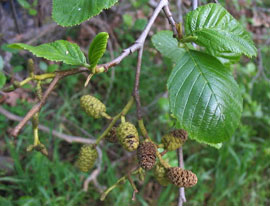
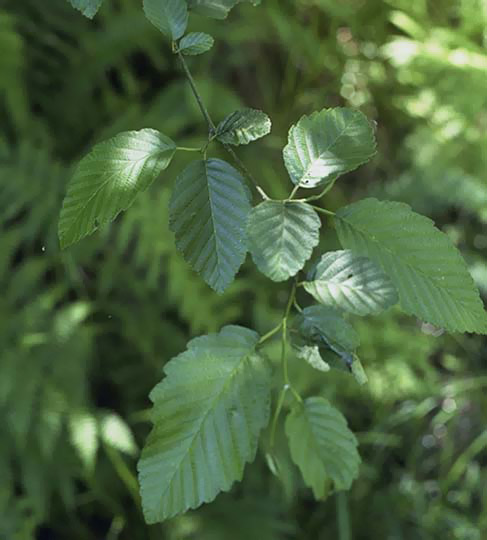
Red alder (Alnus rubra) is a fast-growing deciduous tree that does well in open areas and along streams. This slender, medium-sized tree can grow 5′ or more a year for the first few years, and generally grows to 40-50 feet tall, sometimes reaching as high as 80 feet.

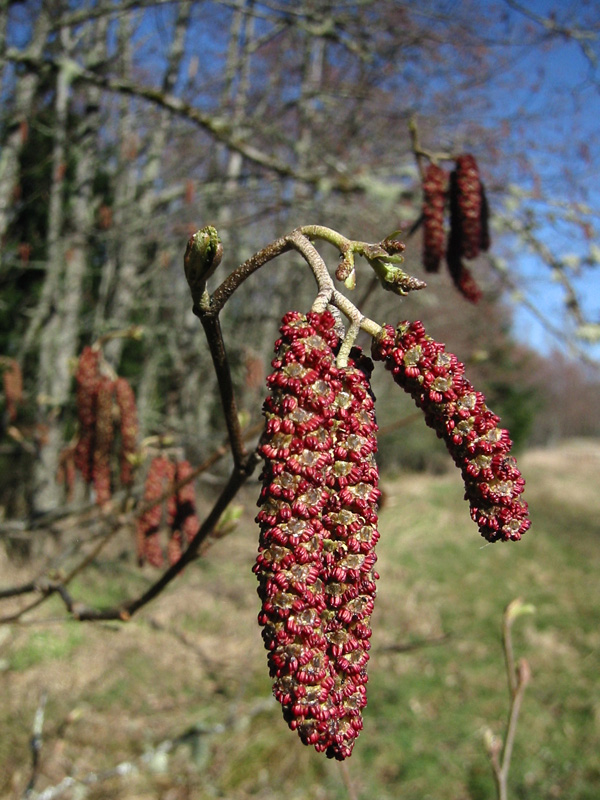
Red alder blooms in March, putting out long, rounded, dangling clusters of reddish-orange flowers called catkins. Leaves turn a slight golden color in the autumn. In the open, alder crowns form a lovely rounded shape with spreading branches.

This tree plays many roles in forested landscapes. Deer and elk browse on the leaves, buds, and twigs. The seeds are important winter food for birds such as redpoll, siskins, goldfinches, and others. Red alder provides food for the young of swallowtail and mourning cloak butterflies, and stands of this tree provide shade for a variety of forest understory plants such as osoberry, vine maple, and sword ferns.

This tree does best in sun to part shade with moist soils. Plant it for fast-growing shade and screening.


  • Light Requirements: Full Sun, Part Shade
  • Water Requirements: Moist
  • Ease of Growing: Easy to grow
  • Growth Rate: Moderate
  • Spreads: No
  • Wildlife Support: Pollinators, Pest-eating Insects, Birds or Mammals
  • Fire-resistant: Yes
  • Edible: No
  • Mature Height: 40-50ft
  • Mature Width:40-50ft

Madrone

Madrone (Arbutus menziesi)
Arbutus menziesii

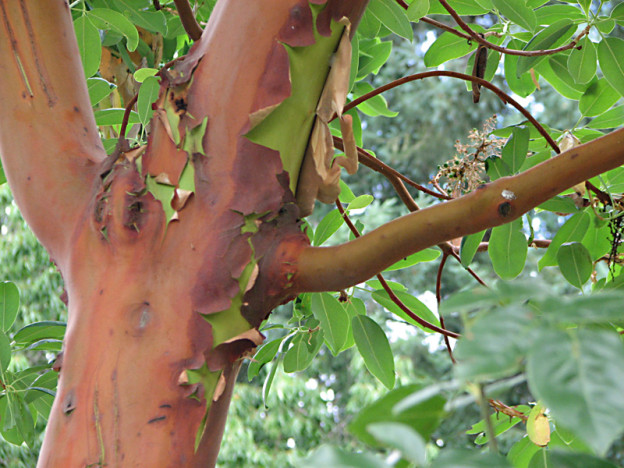
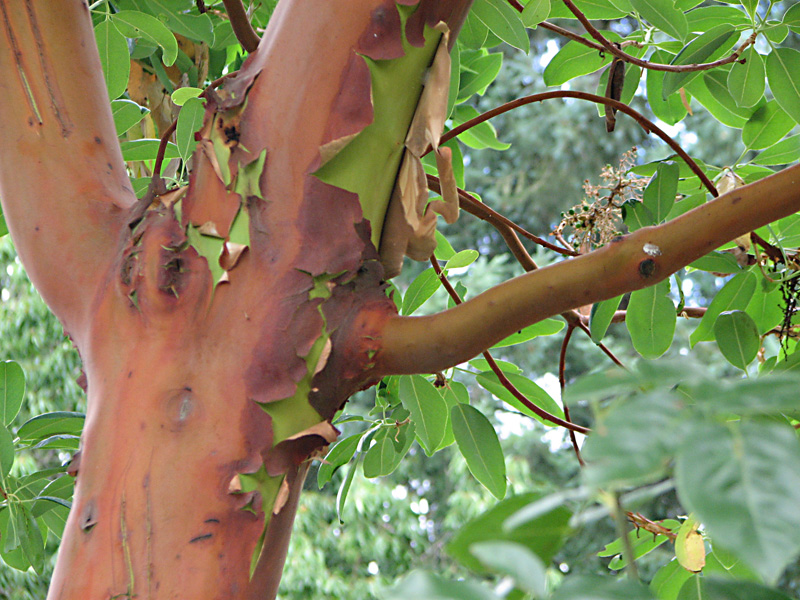
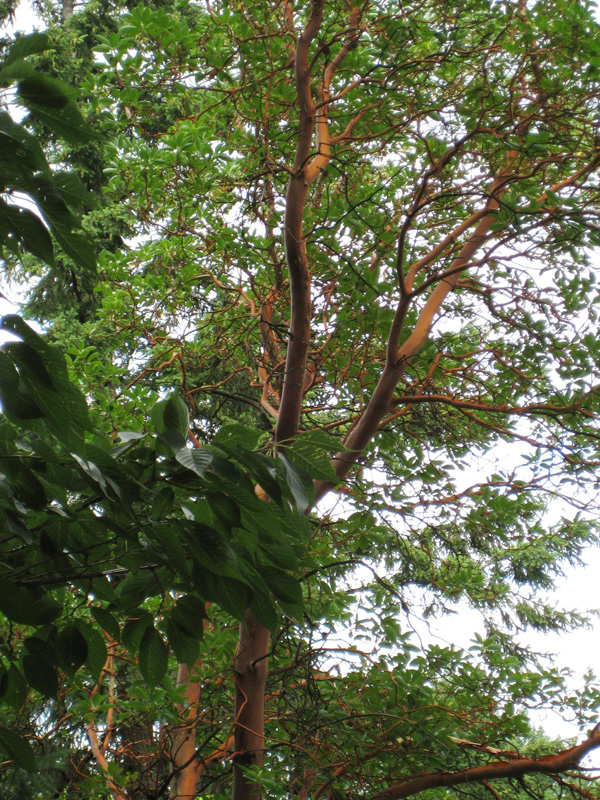
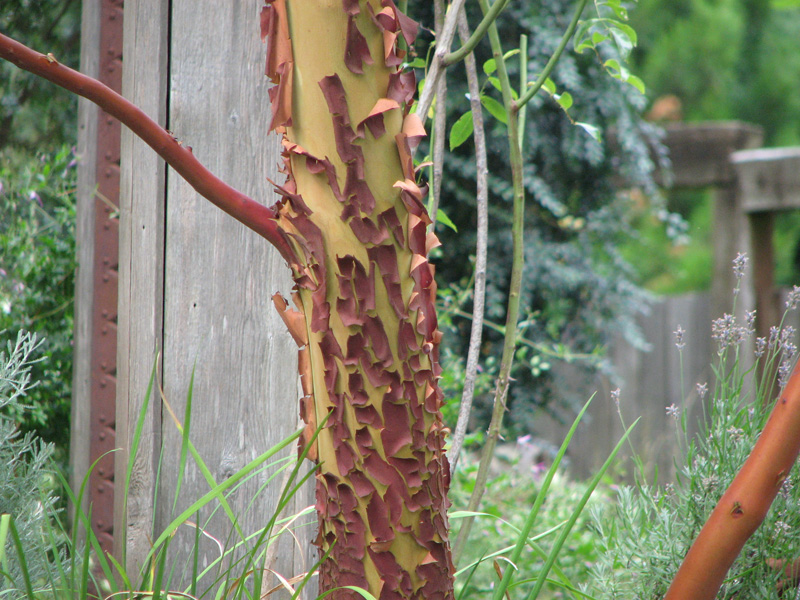
Madrone is an attractive, broad-leaved evergreen tree with a twisting trunk that develops beautiful reddish-brown exfoliating bark with age. Mature size ranges from 20 to 65 feet tall and wide. Madrone does best in full sun and grows well on hillsides with dry, well-drained or rocky soils. Leaves are dark, shiny green and shed irregularly throughout the year.

Flowers are small, pinkish, and bell-shaped, arranged in drooping clusters. Flowers appear in April, followed by small round orange-red berries. Madrone’s fruit is eaten by a wide range of birds and its flowers attract numerous pollinators. They reach their full aesthetic potential when planted in a grove. Madrones can be difficult to establish, so plant small seedlings and be patient.


  • Light Requirements: Full Sun
  • Water Requirements: Dry
  • Ease of Growing: Hard to grow
  • Growth Rate: Slow
  • Spreads: No
  • Wildlife Support: Pollinators, Pest-eating Insects, Birds or Mammals
  • Fire-resistant: No
  • Edible: No
  • Mature Height: 20-65ft
  • Mature Width:20-65ft

Paper Birch

Betula papyrifera

Paper birch (Betula papyrifera) is a medium to fast growing deciduous tree, reaching a mature height of 50-70 feet. The leaves are simple, alternate, to 4 inches long, toothed and roughly egg-shaped, coming to a pointed tip. The leaves turn bright yellow in the autumn. Flowers are male and female catkins to 1½ inches, blooming in the spring.

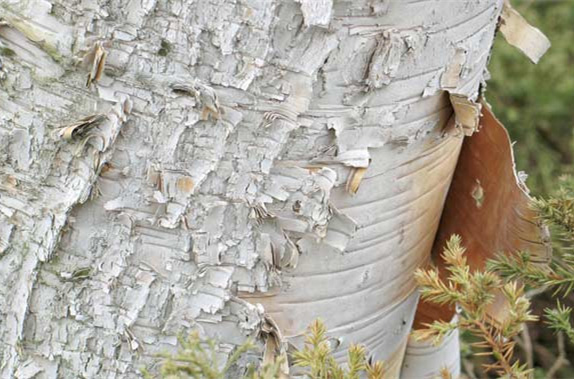
Paper birch is a widespread North American species; on the West Coast, the birch is considered native from eastern Oregon to Alaska. Paper birch is known for its distinctive bark, which is whiter than many birches and peels in papery strips. The bark of the birch was used for canoe-making across the United States outside of the Pacific Northwest (in the Pacific Northwest, Western redcedar is more commonly used). Traditional uses for birch resin include medicine, adhesive, and chewing gum. Today birch is a commonly used for pulp wood and as an ornamental tree.

Because all birches attract aphids and their “honeydew,” the tree is not recommended for patios or parking areas.


  • Light Requirements: Full Sun, Part Shade
  • Water Requirements: Moist
  • Ease of Growing: Easy to grow
  • Growth Rate: Moderate, Fast
  • Spreads: No
  • Wildlife Support: Birds or Mammals, Pollinators
  • Fire-resistant: Yes
  • Edible: No
  • Mature Height: 50-70ft
  • Mature Width:15-25ft

Oregon Ash

Oregon ash (Fraxinus latifolia)
Fraxinus latifolia

Note: Due to the recent arrival of emerald ash borer in Oregon, ash trees in our region are at high risk of mortality over the next several decades. See OSU Extension Service’s emerald ash borer resources page for more information about how you can slow the spread and protect your ash trees.

* * *

Oregon ash is native to western North America on the west side of the Cascade Range from southwestern British Columbia south through western Washington and western Oregon to central California.

It can grow to 80 ft in height, with a trunk diameter of 3ft. The leaves are pinnate, 3.5-10″ long, with 5-9 ovate leaflets. The fruit is a samara, 3-5 cm long including the wing. The leaves turn a striking yellow in the fall.

Oregon ash prefers damp, loose soils, and grows from sea level to 900 meters. It is a dominant tree in local forested wetlands, paired with an understory of spiraea and slough sedge.

Oregon ash is an ideal deciduous tree to plant along streams, seeps, and wet areas. It forms an attractive shape, tolerates saturated soils, and shades waterways.

  • Light Requirements: Full Sun, Part Shade
  • Water Requirements: Moist, Seasonally Wet
  • Ease of Growing: Easy to grow
  • Growth Rate: Moderate
  • Spreads: No
  • Wildlife Support: Birds or Mammals
  • Fire-resistant: Yes
  • Edible: No
  • Mature Height: 70ft
  • Mature Width:25ft

Willamette Valley Ponderosa Pine

W.V. Ponderosa pine (Pinus ponderosa)
Pinus ponderosa

Willamette Valley Ponderosa Pine (Pinus ponderosa var. benthamiana) is a beautiful tree with long needles and attractive bark. Like all ponderosas, the bark of this tree has a vanilla-like scent when warmed by the sun–and they love sunny spots! However, the Willamette Valley Ponderosa is the only variety of ponderosa that can also withstand the heavy wet winter soils of our region.

This long-lived tree is very valuable for wildlife. Its needles are the only known food for gelechiid moth (Chionodes retiniella) caterpillars. Many species of birds and small mammals eat the nutritious seeds and use the needles for nesting material; others use cavities and branches for nesting and shelter.

Willammette Valley Ponderosa Pine is one of four different varieties of Ponderosa Pine, each adapted to different climatic conditions and with differing botanical characteristics. When planting in Multnomah County, it is very important to use this variety, as it is the only one that will thrive in our region.

  • Light Requirements: Full Sun
  • Water Requirements: Dry
  • Ease of Growing: Easy to grow
  • Growth Rate: Fast
  • Spreads: No
  • Wildlife Support: Pest-eating Insects, Birds or Mammals
  • Fire-resistant: Yes
  • Edible: No
  • Mature Height: 150-200ft
  • Mature Width:25-30ft

Black Cottonwood

Black Cottonwood (Populus trichocarpa)
Populus trichocarpa

Balsam poplar (Populus balsamifera) is the northernmost American hardwood, and grows across the continent. Though it appears in upland areas, it thrives in floodplains. It is our tallest native broad-leaved tree, and has dark grey bark. In the spring and early summer the sticky resin on leaf buds releases a strong, balsamic fragrance. It is hardy, fast-growing, and relatively short-lived, though some trees have been known to live for 200 years. Other names are balm-of-gilead, bam, tacamahac, cottonwood, or heartleaf balsam poplar.

Wildlife

The leaves of the balsam poplar serve as food for various caterpillars in the order Lepidoptera. It is an important browse for deer and elk and provides nesting habitat for large birds. The anti-infectant property of the resin is used by bees, who seal intruders in it to prevent decay and protect the hive.

Uses

A great riparian restoration species. The light, soft wood is used for paper pulp and construction lumber.


  • Light Requirements: Full Sun, Part Shade
  • Water Requirements: Dry, Moist, Seasonally Wet, Perennially Wet
  • Ease of Growing: Easy to grow
  • Growth Rate: Fast
  • Spreads: No
  • Wildlife Support: Birds or Mammals
  • Fire-resistant: No
  • Edible: No
  • Mature Height: 175ft
  • Mature Width:40ft
1 2 3